Dry flies
Dry flies are designed to sit on or in the surface film. Many imitate adult mayflies, olives, midges or sedges. They are especially useful when trout are visibly rising and taking insects from the surface.
Dry flies, wet flies, nymphs, buzzers and lures can make a fly box look complicated. This guide explains what the main types are, what they are intended to imitate and how to choose a sensible fly when trout are feeding.
Affiliate · Amazon
A smart wooden fly box with foam fly storage and optional personalised engraving. A practical gift idea for a fly angler.
As an Amazon Associate I earn from qualifying purchases.
Start here
The huge number of available fly patterns can make fly fishing seem more complicated than it really is. At its simplest, an artificial fly is trying to do one of two things: resemble something a fish naturally eats, or create enough movement, shape or colour to provoke a take.
For trout anglers this might mean copying an insect sitting on the surface, an aquatic insect developing below it, a small fish or another food item. Some patterns imitate a particular insect closely, while others are deliberately impressionistic.
Learning the broad types of fly and understanding where in the water they are designed to fish is far more useful than trying to memorise the names of every pattern in a tackle shop.
The basics
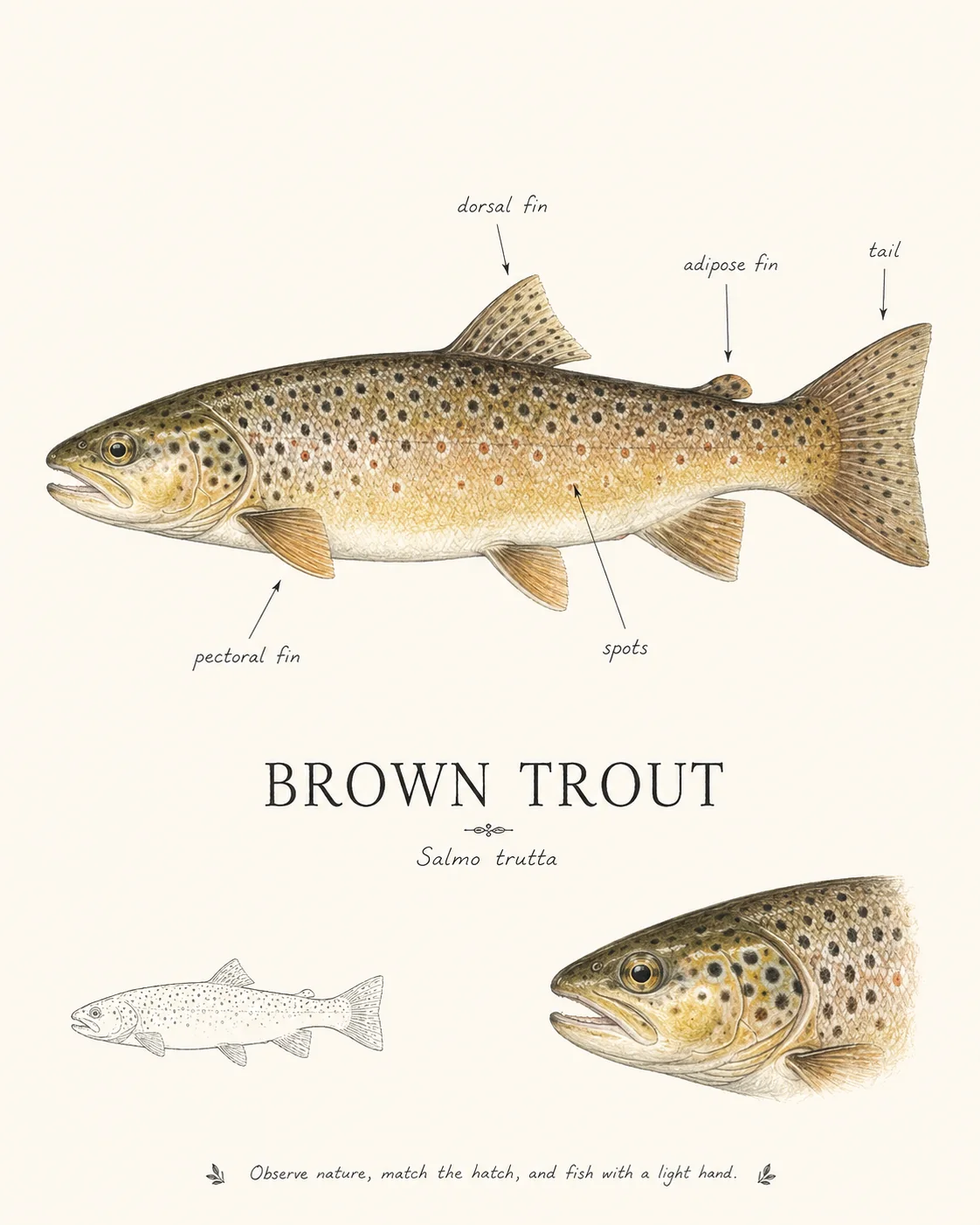
The boundaries are not always rigid, but most trout flies fit into a handful of useful categories.
Dry flies are designed to sit on or in the surface film. Many imitate adult mayflies, olives, midges or sedges. They are especially useful when trout are visibly rising and taking insects from the surface.
Traditional wet flies are fished beneath the surface. Their hackles, wings and bodies can suggest drowned insects, emerging insects or simply a small living food item moving naturally through the water.
Nymphs imitate the immature underwater stages of aquatic insects. They can be presented just below the surface, through mid-water or close to the bottom depending on weighting and retrieve.
Buzzers imitate chironomid larvae and pupae and are a staple of stillwater trout fishing. They are often fished slowly, sometimes as a team at different depths, allowing the angler to find the level at which trout are feeding.
Emergers represent insects changing from their underwater form into winged adults. They are particularly useful when trout are feeding around the surface film but ignoring fully floating dry flies.
These do not necessarily imitate a specific insect. Some suggest fry, leeches or other prey, while others rely on colour, profile and movement to trigger an aggressive or curious response from a trout.
Illustrated guide
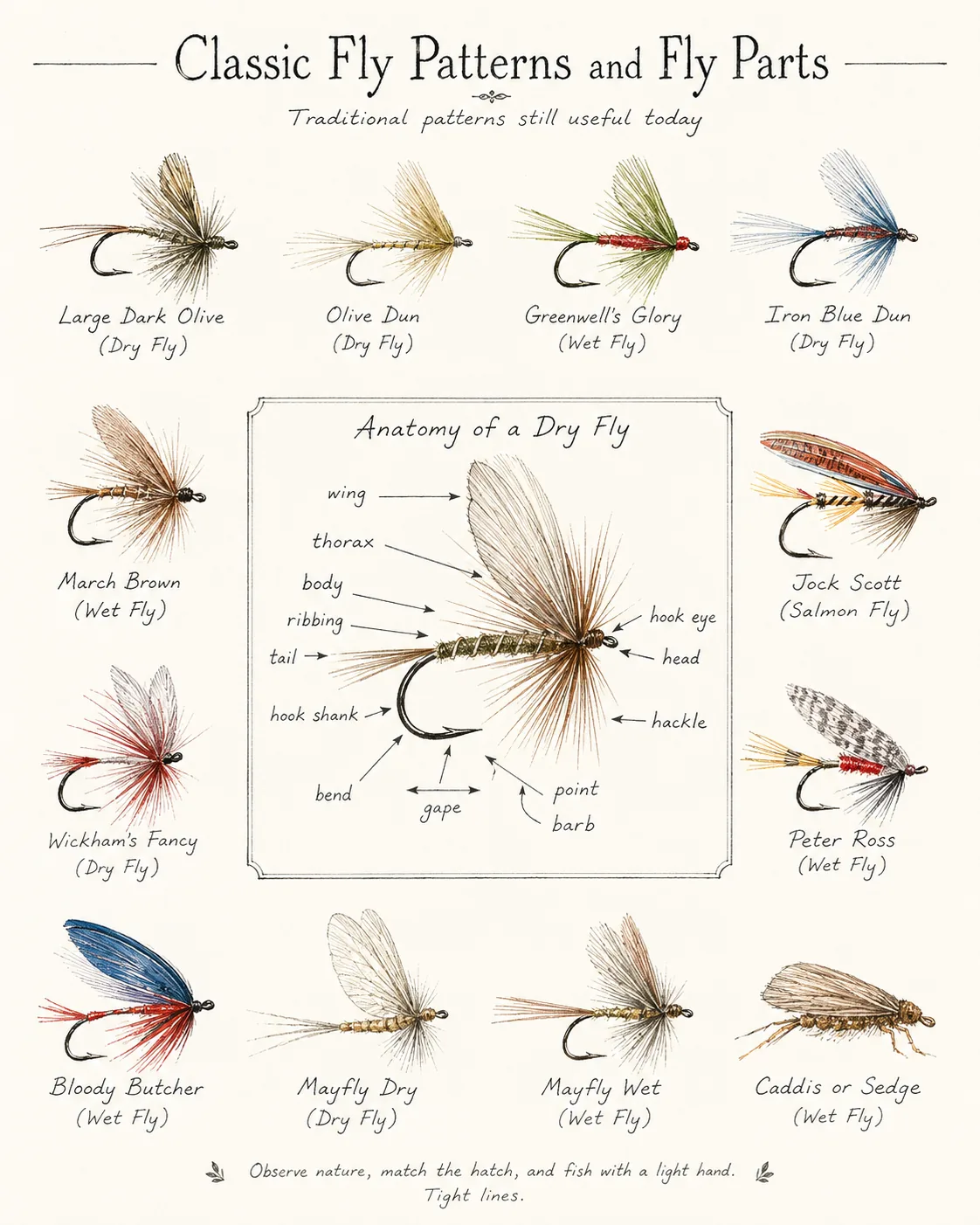
Many traditional British patterns are still recognised today. Several can also be tied and fished in more than one style, so think of the illustration as a guide to classic patterns rather than a rigid set of rules.
Traditional patterns
Olive patterns imitate an important group of upwinged insects. Large Dark Olive imitations are particularly associated with river trout fishing and are normally tied in subdued olive, brown and grey shades.
One of the best-known traditional British trout flies. Greenwell's Glory has been tied in dry and wet styles and its general shape and colouring allow it to suggest more than one natural insect.
A classic pattern associated with the Iron Blue family of upwinged flies. Its darker body and blue-grey appearance make it noticeably different from many paler olive imitations.
March Brown is one of the most famous names in traditional British fly fishing. Dry and wet dressings exist, although the importance of the natural insect varies greatly from one river system to another.
A bright traditional attractor rather than an exact copy of one particular insect. It remains a familiar pattern and is a good example of a fly designed to suggest life and attraction rather than perfect imitation.
A striking traditional wet fly recognised by its strong contrasting colours. It has a long history in British and Irish game fishing and can still be encountered in modern wet-fly selections.
Another classic winged wet fly. It can be fished by itself or as part of a team and represents the traditional style of wet-fly fishing that remains effective on suitable rivers and stillwaters.
The elaborate Jock Scott belongs primarily to the history and tradition of salmon fly fishing rather than the everyday stillwater trout box. It remains one of the most recognisable classic salmon fly designs.
These remain extremely relevant. Different patterns imitate adult insects, emergers, pupae and other life stages. The right presentation depends on which stage the fish are actually feeding on at the time.
Fly anatomy
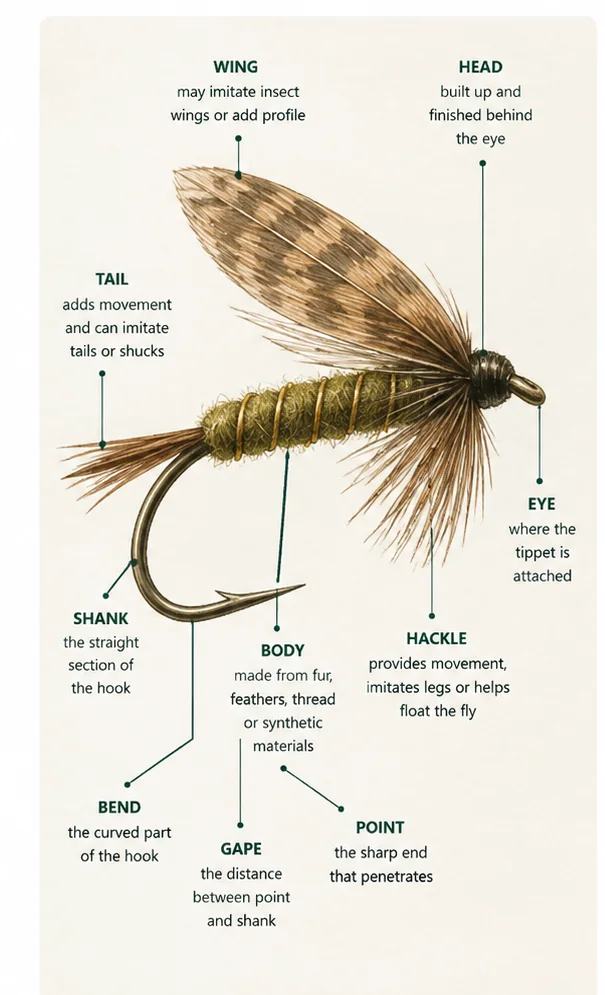
Fly patterns can look completely different from one another, but many are built from the same basic components.
The hook eye is where the tippet is attached. Immediately behind it is normally the head, created as the tying materials are secured. The body runs along the hook shank and may be made from natural fur, feather fibres, thread or synthetic materials.
Ribbing is wrapped around the body on many patterns. It can strengthen the fly, create segmentation or add flash. A tail extends from the rear of many flies, while wings may imitate natural insect wings or simply contribute to the fly's profile.
Hackle is feather material tied around or along the fly. Depending on the pattern it may imitate legs, provide movement or help support a dry fly at the surface. The thicker area towards the front of many insect patterns is called the thorax.
The hook itself consists of the shank, bend, gape and point. Some hooks have a barb, while others are manufactured barbless or have the barb removed.
Reading the water
Matching the hatch is less about knowing a Latin insect name and more about noticing what the trout are eating and presenting something sufficiently similar.
Are trout taking insects directly from the surface, bulging just underneath it or feeding deeper down? Depth is often more important than the exact fly pattern.
A fly that is dramatically larger than the natural insects can look wrong even when its colours are perfect. Start with roughly the same size and profile as the food you can see.
Exact colour matching is not always necessary, but the general silhouette, shade and amount of material can make a significant difference when trout are feeding selectively.
Some insects drift almost motionless while others swim, rise or skate across the surface. Try to make the fly behave naturally rather than concentrating only on how it looks in your hand.
Stillwater trout
Resist the temptation to start casting the moment you reach the bank. Spend a few minutes watching the water first. Rising trout, insects on the surface, bird activity, wind direction and activity around weed beds can all provide useful clues.
Try an appropriately sized dry fly or emerger. If fish are repeatedly rising but ignoring the dry, look carefully at whether they are actually taking insects in the surface film rather than fully on top.
Nymphs and buzzers allow you to explore below the surface. Change depth before changing fly every few casts. Finding the feeding depth can transform an apparently quiet lake.
A lure or streamer can cover more water and provide a stronger visual and movement trigger. Retrieve speed, depth and pauses can matter just as much as the particular pattern.
Beginner fly box
Not many. Experienced anglers often accumulate boxes containing hundreds of patterns, but a beginner is better served by a smaller selection that covers several depths and feeding situations.
As you fish particular waters more regularly, you can add patterns that suit the insects, conditions and fishing methods that work there. A small box you understand is more useful than a huge box of flies you chose because the names sounded impressive.
Common questions
A dry fly is intended to fish on or in the surface film. A wet fly is normally fished below the surface. Their materials and construction often reflect the way they are intended to behave in the water.
There is no single best trout fly. The best choice depends on the water, season, weather, feeding depth and what the trout are eating. Choosing the correct depth and presentation is often more important than finding one supposedly magic pattern.
Yes. Many traditional flies continue to work because the insects and food they suggest have not disappeared. Modern materials and patterns provide more options, but an old pattern does not stop being useful simply because it was designed generations ago.
Usually not. Size, silhouette, depth and behaviour can be more important than producing a perfect replica. Trout can become selective during some hatches, but many successful flies are deliberately suggestive rather than exact.
That depends on the venue and method. Many fisheries have their own hook rules. Always check the fishery's current requirements before fishing rather than assuming the rules are the same everywhere.
Ready to find somewhere to fish? Browse our UK fishing lake directory, explore waters by county or discover more practical fishing guides. We are also building dedicated fly-fishing and trout-fishing lake guides to make suitable waters easier to find.
Affiliate · Amazon

As an Amazon Associate I earn from qualifying purchases.